
11 months ago, I sat on the tarmac in Niger’s International Airport at Niamey, watching my trip evaporate due to visa complications. The Niger Embassy in Washington D.C. had stopped issuing visas to Americans entirely.

But I don’t give up. In late October 2025, I reconnected with Culture Road’s founder, Rik Brinks and their local contact Yaou of Zenith Travel, securing ministerial support for Niger’s new (and therefore super untested) tourism-based visa on arrival. The conversation was remarkably straightforward:
October 28, 2025 – WhatsApp exchange:
- Yaou: “Send me your dates.”
- Me: “My dates are December 7-9, arriving midnight at 12:05am (late night December 7, beginning of the day of December 8). Departing December 9 at 15:10.”
- Yaou: “Ok”
That was it! No document requests, embassy appointments, or three-month processing times. Just confirming dates. Within a month, I got my visa on arrival authorization in a PDF document via What’sApp:
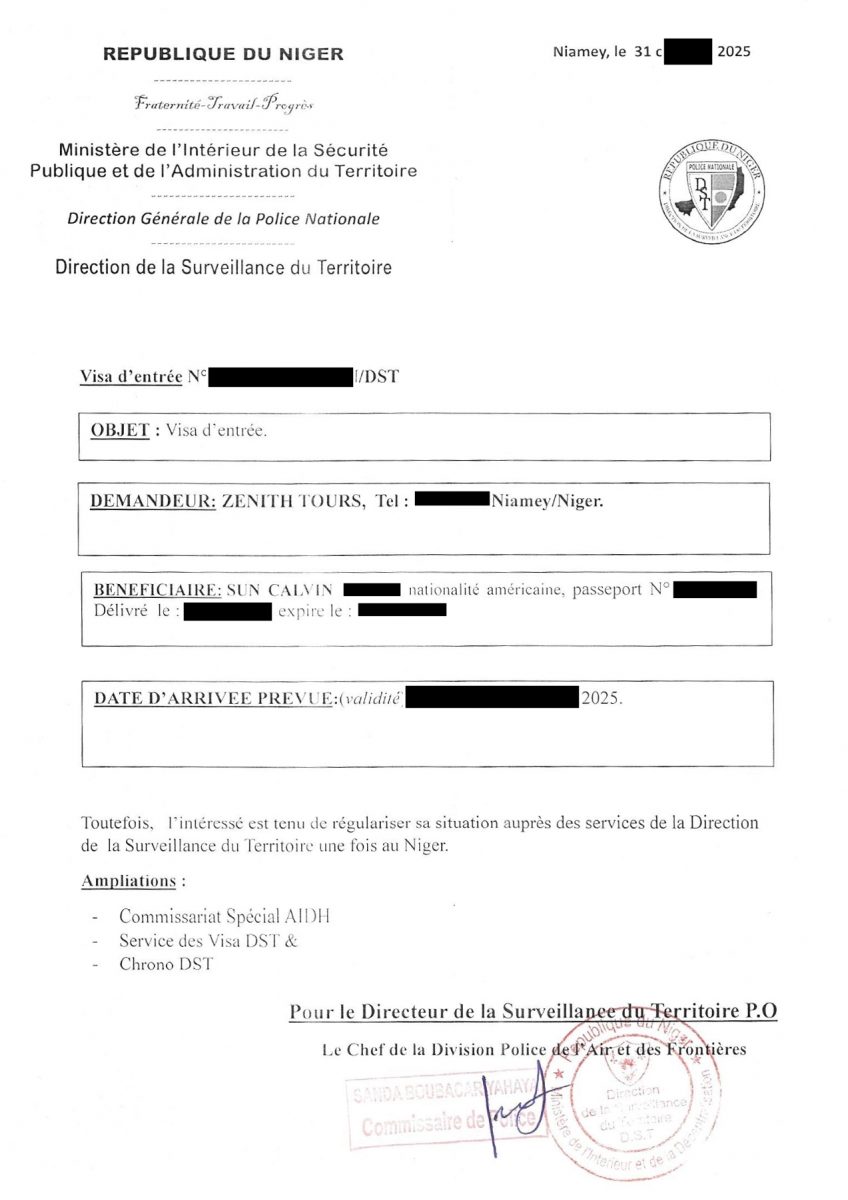
November 1, 2025 – The gamechanging question:
- Me: “So this means our Visa on arrival is confirmed? I heard from prior months that it’s not always 100% reliable, unless recently it got better?”
- Yaou: “Yes, there has been a change. The Minister of Tourism supported our request within the tourism framework. Since then, we have started receiving visas, albeit at a slow, not accelerated, pace. This is a sign of improvement, and we hope it will continue in the right direction.”
Approved tour operators can apparently now secure visa on arrival authorization through the Ministry of Tourism. It’s still not advertised publicly or guaranteed forever…but I guess if this post exists, then it works.
I still had two active visa applications pending: one at the Washington D.C. embassy (which no longer processes American applications) and one at Copenhagen. Yaou’s advice, however: “You can tell Copenhagen and Washington, D.C., not to follow up on your application; you already have the visa.”
November 4, 2025 – Flight change: Turkish Airlines then moved my midnight arrival to an overnight flight (ughhh) and therefore morning landing at 6:05am on December 8.
One WhatsApp message to Yaou. “Ok no probleme.. noted.”
The Route: Cairo → Vienna → Istanbul → Niamey
After saying goodbye to Bruce in Cairo following our day at the new Grand Egyptian Museum and our week in Yemen (where we stumbled upon what will likely become the world’s next newest country right as it all went down), I boarded a mid-afternoon flight to Vienna.

The Moxy Airport Vienna, conveniently next door to the terminal, provided a quick overnight before my 6am Turkish Airlines flight to Istanbul.

Route breakdown:
- Cairo (CAI) → Vienna (VIE): [flight details]
- Overnight: Moxy Airport Vienna
- Vienna (VIE) → Istanbul (IST): Turkish Airlines Business Class, early morning departure
- Istanbul layover: 13 hours
- Istanbul (IST) → Niamey (NIM): TK 635, departure 1:10am
- Arrive at 7:00am local time.
The Turkish Airlines Business Lounge at Istanbul Airport has become my de facto office for long layovers. Thirteen hours sounds excessive, but it doesn’t compare to the 28 hours I once spent at this same airport heading to Mali. Time passed quickly as I used their reliable WiFi to catch up on blog posts and binge A House of Dynamite on Netflix.
I also created an unasked-for scavenger hunt looking for a lost hoodie I though I misplaced on a side couch in the lounge upon arrival. After a few hours retracing my steps, I found it on a random dining table (which I forgot I had temporarily considered to settle down at) just before boarding to Niamey.
Drama at the Gate
At Concourse B, the gate agent examined Yaou’s visa on arrival letter with visible confusion. “I’ve never seen this before,” she said, holding the paper at various angles as if perspective might clarify things. After several minutes texting a supervisor on WhatsApp and photographing my letter, she let me sit inside the gate while we waited for final approval. When boarding began, she was already about to scan passengers behind the gate desk before she spotted me: “Oops, my bad. You’re fine. I just never seen that before. You can board.”
Unlike eleven months ago when this same flight to N’Djamena required boarding a bus that drove us in circles before a false alarm forced a second attempt at this hour, this time we boarded efficiently through an actual gate and jet bridge. Progress.
TK 635 to Niamey and onward to N’Djamena takes approximately six hours before the Niamey stop. I managed about five hours of fragmented sleep, which was better than last year’s attempt and therefore better than nothing. And just like last time, most passengers continued to N’Djamena; only a handful of us deplaned in Niamey.
The Arrival Gauntlet
We arrived thirty minutes ahead of schedule, though the time savings evaporated in this gauntlet of disembarkation. Passengers immediately encountered a woman stationed at the aircraft door on the jet bridge, examining passports before allowing anyone to proceed.

And then behind her, a line of soldiers inspected documents.

Again: show passport, VOA letter, receive a little of skepticism, and proceed.


Downstairs at immigration, I filled out an entry form before approaching a desk. After several minutes of fingerprint scanning, the officer took my VOA and passport to a senior officer two desks down. This is where things got interesting.


Over the next thirty minutes, the senior officer asked:
- “Call the person retrieving you.”
- [After I reached both Yaou and my guide Harouna via What’sApp on Google Fi (the airport WiFi was much slower), the officer spoke to Harouna] “Come inside.”
- [After Harouna explained he wasn’t permitted inside] “Let me speak with the officer at the exit.”
- Then a text from Harouna: “I got a pass to come inside.”


Minutes later, Harouna appeared at passport control to vouch for me in person. Several other VOA holders, mostly engineers and contractors, had their contacts retrieve them first. I was the last VOA holder remaining. Once we were alone, the senior officer asked about my profession. I explained I’m a physician visiting as a tourist. His next question then caught me off guard: “What would it take for you to stay longer in Niger and live here?”
I spent all this effort getting in as if you never wanted me, and now you want me to stay forever? I responded by asking if there were openings for doctors. He gave genuine, warm laughter: “Welcome to Niger.”
The stamp came down. But per Niger’s regulations, he would retain my physical passport for final processing, providing me instead with a paper slip I’d need to retrieve my passport later that day at another office in Niamey.

I walked out of the airport without my passport, trusting a system I’d never encountered before, to explore a country that had rejected my visa attempt eleven months earlier.


After 11 months, I finally set foot in country #192.

Driving into early morning Niamey, I noted signs of development: red-yellow-green stoplights that work, giant water tanks to capture fresh rainwater for its citizens, and regular civilians (or at least people in civilian clothes) casually working out and jogging on the street. 11 months ago outside N’Djamena’s airport, I’d seen only military troops jogging at this hour instead.

Harouna and the driver offered to attempt early check-in at the Noom Hotel. Standard check-in: 3pm. Our arrival: 7:15am. They let me check in anyway.

Pleased, Harouna said he’d return at 10am while both he and the driver needed rest. As I settled in, Yaou soon then texted instructing me to bring two passport photos and my slip to reception for passport retrieval. Thankfully, I always keep emergency backup passport photos (otherwise Yaou would’ve sent someone to photograph and print quickly), so I left both those and my passport slip with reception.
When they looked confused, I then called Yaou and he explained via speakerphone. I also asked the hotel staff for a xerox copy of the slip just to be safe, then went back upstairs, showered, napped for an hour, and emerged at 10:05am refreshed and ready.
Harouna and the driver were already there waiting for me to begin the official tour.

Watching Harouna, I learned that in Niger, greeting with “Salaam alaikum” followed by “Bonjour/Bonsoir, ça va?” disarms everyone here. This combination of an Arabic Islamic greeting plus French colonial language acknowledges both Niger’s religious identity (90%+ Muslim) and its administrative language (French). Use it.
Niamey Proper: The Unfiltered Tour
Our hotel is conveniently located next to the Palais des Congres, where government governs.

The Slaughterhouse

Harouna wanted to first show me their open-air slaughterhouse; essentially what happens in Western factories behind closed doors and regulatory obscurity, except here it occurs in full public view.


Cattle, goats, and sheep processed on-site. Blood, hides, meat, bones, and waste all visible in morning light. The efficiency was remarkable: nothing wasted, every part utilized. It’s pretty intense for a first tour stop, but we’re jumping into the deep end here in Niger.


The gorier content lives in the formal Flickr album dedicated to Niamey:


Those passionate about animal rights or with queasy stomachs should beware coming here.


Kodako Recycling Market

From the slaughterhouse, we drove to the Kodako recycling market.


The first notable part of the market here, to keep it on theme, is where meat is dried using traditional methods. A man I had to charm to photograph cuts strips of beef and goat . . .

. . . that are stretched out on tables, slowly dehydrating in Sahelian air to become jerky, a preservation technique predating refrigeration by centuries and still preferred for flavor.


The market sprawled across a large area, combining recycling operations with food processing: plastic sorted here, electronics disassembled there, meat drying in between. Informal economy at scale.
Bridges, lots of them
From Kodako, we drove onto Pont Général Seyni Kountché spanning the Niger River. Harouna proudly noted it was built by the Chinese. No additional context needed; Chinese infrastructure investment in Africa is ubiquitous enough that this single sentence suffices. We’ve seen it all.

The bridge was modern, functional, and noticeably better-maintained than older infrastructure—a pattern visible across Francophone Africa wherever Chinese construction has replaced French colonial-era projects.


They also drove me to another Chinese-built bridge.

We walked both, admiring the river beds and marshes growing along the fast-moving current.

Once across, we left Niamey proper, driving through villages on the city’s western outskirts. Mud-brick compounds, thatched roofs, livestock wandering freely, and the pace of life existing beyond capital cities everywhere in the Sahel.


Roundabouts, lots of them
Niamey features a series of creative roundabout statues marking different symbols of various Niger tribes.


Embassy Row, aka Architectural Biennale
Returning to Niamey, we made several passes along Embassy Street, which felt like an unintentional architectural exhibition. Each country’s consulate reflects national aesthetic preferences: French neoclassical, American fortress modernism, Chinese block contemporary, Nigerian West African blockbuster, Arab Middle Eastern palace. All on one street, competing for visual prominence. I felt transported to Venice’s Biennale or a World Expo.


Cruising back along the Niger River past the Presidential Palace, we admired spectacular greenery rare for this part of the Sahel, and roadside greenhouses set up by the river banks.

We returned to the hotel where Harouna insisted I take lunch there while they took a 3-hour siesta. Not wanting to offend, I used the hotel gym for two hours, creatively working with dumbbells; the only equipment besides a single treadmill and two bikes.
I then had my lunch at the hotel restaurant before they closed. By 4pm, Harouna returned to continue our tour.
Kennedy Bridge
We drove to the first bridge across the Niger at Niamey, reportedly built with U.S. assistance and named after JFK. This bridge represents earlier American engagement in West African infrastructure before Chinese investment dominated this sector.

We then visited the Grande Mosquée, a gift to Niger from the late Libyan dictator Muammar Qaddafi.


You pay “whatever you think is appropriate” to enter. Since I didn’t have local currency (Central African Francs or CFAs), our driver paid 5,000 CFAs on my behalf. I promised to pay him back.


The women’s section behind the men’s area fits 1,000 people.

The imam explained how Libyans built the mosque, Chinese installed the sound system, and Italians donated a water tank and, most importantly in this heat, a single air conditioner.

After 20 minutes at the Grande Mosque, we drove to Terminus Hotel, the location of Yaou’s office and essentially HQ where everything happens, including visas.

I thanked Yaou in person and gave him a hug for all his help over the past two years getting me into both Chad and Niger. He then returned the gratitude by retrieving my passport with the formal visa stamp from his office.

Finally, my passport returned with an official Niger visa: The stamp I’d tried obtaining for over a year through Washington D.C. and Copenhagen embassies, spending countless hours on applications that went nowhere. All told, I parted with my physical passport for just 9 hours to get a visa in the very place I was trying to enter with said visa. How ironic. How poetic.
I used Yaou’s ATM in the Terminus Hotel lobby to repay our driver for the mosque and have enough for early dinner to celebrate.
Cap Banga Restaurant
No Niamey journey would be complete without a Niger River boat ride. Harouna wanted somewhere special: a restaurant literally built in the middle of the river. To get there, we drove to the river banks and then boarded a small dinghy.

Don’t lose your balance boarding or your trip ends quickly.

We took about a 20 minute boat ride up the river.


The sunset vibes here are impeccable.

It sets before you even know it:


If you don’t mind insects, this place is worth the atmosphere.


By 7pm after finishing dinner, we took the boat back to the river banks where our jeep was parked, then drove to my hotel for the night.


Before bed, I reflected on the absurdity and beauty of traveling at this level. 11 months between visa attempts, finally successful. Try and try again. It’s all about patience, hitting while the iron’s hot, and avoiding procrastination. Beware the psychology of postponement or else things simply won’t happen in life. The secret here is a consistent flexibility in persistence.
I can’t say Niger will remain difficult for Americans indefinitely. Windows open and close. Political situations change. What didn’t work December 2024 worked December 2025 and might not work December 2026. Even starting this trip last week in Yemen demonstrated impeccable timing; we literally arrived just as a forced government change happened, which will likely make foreign entry more difficult again.
Day 2: The Final Countdown
Waking at 6:30am after nine and a half hours of sleep, I enjoyed a morning sunrise swim in the outdoor full lap-length pool before the sun’s heat arrived.

After 20 minutes of lap swimming, oddly more tiring here than pools back home, I switched to cardio at the gym upstairs for half an hour, then enjoyed hotel breakfast. Harouna and our driver returned at 10am to continue our tour.
The Artisanal Village
We first visited the artisanal village for souvenir shopping: metalwork, bracelets, leather goods, jewelry, textiles, woodcarvings, and the country gift shop every tour exits through. Prices are negotiable. I bought two metal bracelets for 7,000 CFA after negotiating down from 14,500 CFAs, telling them I literally had only 6000 CFAs remaining; Harouna would lend me an extra 1000 CFAs (I’m honest with them, even when haggling!).

There’s more shops in the back:

Animal Market
Harouna next took me to the livestock market where cattle, goats, sheep, and camels are inspected, bought, sold, and transported.

Where rural Niger meets urban demand: farmers bring livestock to city buyers, middlemen negotiate prices, and the informal economy keeps the engine running. Harouna made his point from last night about Niger’s meat abundance: “Everyone eats meat. Too much meat. So many animals in Niger.”

Look how much food is needed to keep this market going everyday:

Cathédrale de Maourey.
I specifically then requested to add in the Cathédrale de Maourey. In a country that’s over 90% Muslim, the cathedral represents Niger’s small but significant Christian minority, such as migrants from southern Nigeria and other coastal West African nations. The architecture blends French colonial church design with local materials and decorative elements.

We greeted the caretaker inside who didn’t expect our arrival. He unlocked a side door for us to explore inside, then showed us a nearby smaller chapel.


We then went to a nearby smaller chapel.

Afterwards, we returned to the hotel where I collected my bags, checked out, and withdrew more cash from their ATM to repay Harouna for lending me 1,000 CFAs, plus gratuity for both him and our driver.
National Museum
We then set back out for the final leg of our tour at the next door National Museum, founded by Boubou Hama.

More than a museum, this place is actually a zoo with museum buildings scattered throughout: lions, hawks, turtles, zebras . . .

….adult and their baby hippos…

. Small indoor structures house exhibits on history, tribal clothing styles, archaeological finds, dinosaur fossils excavated by Americans in Niger . . .


. . . a desert tree that once marked groundwater sources for travelers. After a car crashed into it and felled it, they transported it here rather than let it rot.

. . . and even a hall on the massive uranium deposits native to Niger. This is why France maintained such strong interest in Niger.

I didn’t know a cow like this existed. Is this a fossil of an extinct kind?

. . . never mind.

If you consolidated all indoor exhibition space, you’d have a small museum. Instead, imagine an outdoor museum interspersed across grounds where hippos, zebras, lions, birds, crocodiles, and various other wildlife roam between small, topic-specific exhibition buildings. And if you forgot souvenirs, there’s another and more lively artisanal village in the back of the museum grounds.

Grande Marché
Finally we made one last stop at the Grande Marché and the largest market in Niger.

This is the country’s premier covered commercial center with over 5,000 stalls. Everything’s here: textiles, metalwork, spices, electronics, livestock, traditional medicine, modern goods, and the organized chaos defining West African market culture.

Be mindful of walking around here on your own; Harouna warned of plenty of sticky fingers here.


After 30 minutes walking around the market, Harouna and the driver dropped me at the airport, only twenty minutes outside Niamey.

We hugged farewell in the parking lot, and I set off on my solo journey home.


Niamey’s airport (NIM) displays some dinosaur fossils in the departures hall, which looks like a tradition carried over from their old pre-2019 airport.

Then the show begins: At the first security check to reach check-in desks, the guard seemed confused why I was flying to Ouagadougou. I explained it was only a transit stop to Brussels, Belgium, then Zurich, Switzerland, then Newark to get home (this complicated itinerary courtesy of a 70K miles business class redemption: the only business class option home from NIM).
He said with my USA passport, I needed a visa for Belgium. I explained that Belgium being part of Europe, I didn’t. He then said at least for Switzerland, I definitely needed a visa as an American. Again, I said no. He didn’t believe me but let me proceed to check-in. He asked the check-in desk if this was true; they confirmed I was fine. He seemed skeptical. Was he confusing me with a Chinese passport holder?
At check-in, they were shocked I had no bags to check…as if I was the first traveler who backpacks and knows to “never check a bag” to minimize lost luggage frustration. They then asked me about the weight of both my bags, even though as a business class passenger I was entitled to bring both onboard. I told them accurately (8-9kg and 12-14kg, respectively). They made me weigh them anyway, continuing skepticism. Et voila: 9kg and 14kg. Defeated, they issued my boarding pass. I noted no onward tickets printed for Ouagadougou to Brussels, Brussels to Zurich, Zurich to Newark. They said I’d get onward tickets in Ouagadougou. Uh oh. Ouagadougou is not exactly a world-renowned transit hub that would hopefully know how to deal with these things.
Upstairs at another security round, even after clearing X-ray, they mandated opening every bag and every smaller bag inside those bags. They unzipped every zipper, even re-opening things when they lost track of what they’d already inspected. After 10 minutes, they confiscated my disposable razor (fine), a tiny plastic mirror in my toiletries bag (sad, it survived this long although fine, I never used it), and a small nail clipper (also sad…it was a souvenir from the now-extinct Robot Restaurant in Japan). I guess this is why people check their bags here. This also reminded me how this part of Africa nitpicks over items nowhere else in the world does…but then again, we still have that weird arbitrary 3-1-1 liquids rule back home.
After security, I sat alone in this entire departures hall by myself. Might as well be my very own oversized business class lounge.

Walking toward the bathroom after 20 minutes trying to connect to the terrible WiFi, I finally noticed a business class lounge called BLU sponsored by Radisson Blu Hotels. Scanning my ticket, I enjoyed another whole room to myself …much cozier and less isolating than the departures hall.

The woman managing the lounge inside asked if I wanted hot food. I said no thanks given that we were boarding soon, but she brought out hot food from the fridge anyway and lit canisters underneath to warm it. I pointed out my flight had already arrived from Addis Ababa and again, that we’d board soon. She said it would be warm by then. 6 minutes later, staff told me to board. I did a taste test and small bite of the “hot” food … still ice cold. Oh well.
I thanked the lady who tried her best to feed me a warm meal (the kind of care is more than most strangers have given me, hah!) then proceeded to the gate. However, the same guy from downstairs who’d done my first security screening somehow reappeared again like a mischievous court jester, saying again he was unsure if I could enter Belgium with my USA passport. Wow, he also cares more about my travels than some of my own friends. I was touched. But are we on the same planet? Where did he come from? Does he know something I don’t?
As he was chatting me up, another security officer next to him asked to go through my bags again: a third security screening within the past hour. I let her. But then when she saw how many bags were in bags in all my bags, she gave up after 5-6 minutes and let me finally board. Nobody expected this solo traveler to not check a bag. The guy next to her once again wished me luck getting into Europe, or Switzerland, “or ‘Newark… is that United States?'” as I walked onto the jet bridge. I wished him the same.
Walking onto Ethiopian Airlines’ Cloud Nine business class cabin to Ouagadougou felt like a world shift, suddenly surrounded by people who knew where I was going and that I didn’t need a visa for Europe. The flight was a quick 45 minute jaunt during which I snacked on canapés and worked on this blog post live.

Landing in Ouagadougou (my third time! I guess it really is turning into a travel hub), I disembarked, hopped on a bus, and was driven to arrivals. I desperately didn’t want to be shaken down for not having a formal Burkina Faso visa; the one from my 2023 week-long visit had expired. They made me go through the process anyway. For the first time this trip, we were asked for Yellow Fever cards. Thankfully, like backup passport photos, I always keep my laminated Yellow Fever vaccine card ready.
After health inspections, I asked about the process for transiting passengers. The officer pointed me to the visa office. The visa office guy said I was at the wrong place, pointing me to his assistant who pointed me back to the officers. I ignored the officers. But then the assistant disappeared before I could ask for alternatives. I then approached a few women who looked in charge standing past the officers. They were more helpful: they gave me an entry form and told me to write “Transit” in all areas asking for trip purpose, Burkina Faso address, and duration of stay (I added “6 HOURS”).
With this form, I thanked the women and proceeded to passport control, where the officer understood, saw a digital copy of my Brussels itinerary, and stamped me into Burkina Faso. How would he know I wouldn’t use this as an opportunity for a formal visa on arrival and explore the whole country for a week?


Look at the stamp. It doesn’t specify transit, so I could have totally entered Burkina Faso claiming I was a transiting passenger, showing a random itinerary, not paying the relatively expensive tourist visa fee, and exploring like a tourist before leaving in a day or two. Not sure if this travel hack would be worth exploiting at the risk of detainment.
I’m now typing this outside departures, where they won’t let you enter until 3 hours before flight for formal check-in. This is exactly the same situation I faced leaving Paris and our group early for my Freetown flight in 2023: sitting outside for hours with no WiFi, no internet, nothing to do but pass time and practice meditating.

And leaving notes for people to find.
2 years ago giving instructions on where I left a note:

Today: confirming she had found it!


During my wait outside departures, I had to turn on my ThermaCell device to ward off mosquitoes. One still got me in the ear, so I escalated to DEET and put headphones over my ears for protection. I then noticed the departures board was missing my flight…there was the Brussels Airlines flight to Abidjan, but no direct flight to Brussels listed.

Checking my Flighty app and asking the gate officers confirmed what I suspected: the 16:50 Brussels Airlines flight to Abidjan would return as an immediate turnaround to take us onwards to Brussels overnight as scheduled. Their board was just missing a few things.
At 7pm check-in, officers guarding departures wanted to see my e-visa before letting me through; my arrival stamp wasn’t enough. I explained I was a transiting passenger for the past 3 hours after arriving from Niamey earlier this afternoon and showed my itinerary. They eventually let me proceed.
At check-in, I received only two boarding passes: OUA to BRU and BRU to ZRH. My onward ZRH to EWR flight would need to be printed during my 40-minute Zurich layover: tight, but manageable if everything ran on time. The officer stamping me out of Burkina Faso was the friendliest yet, understanding my situation immediately.
Through passports and another security round, which was a lighter version of Niger’s more thorough screening, I headed upstairs to the business class lounge, which had received a major upgrade since my last visit two years ago:
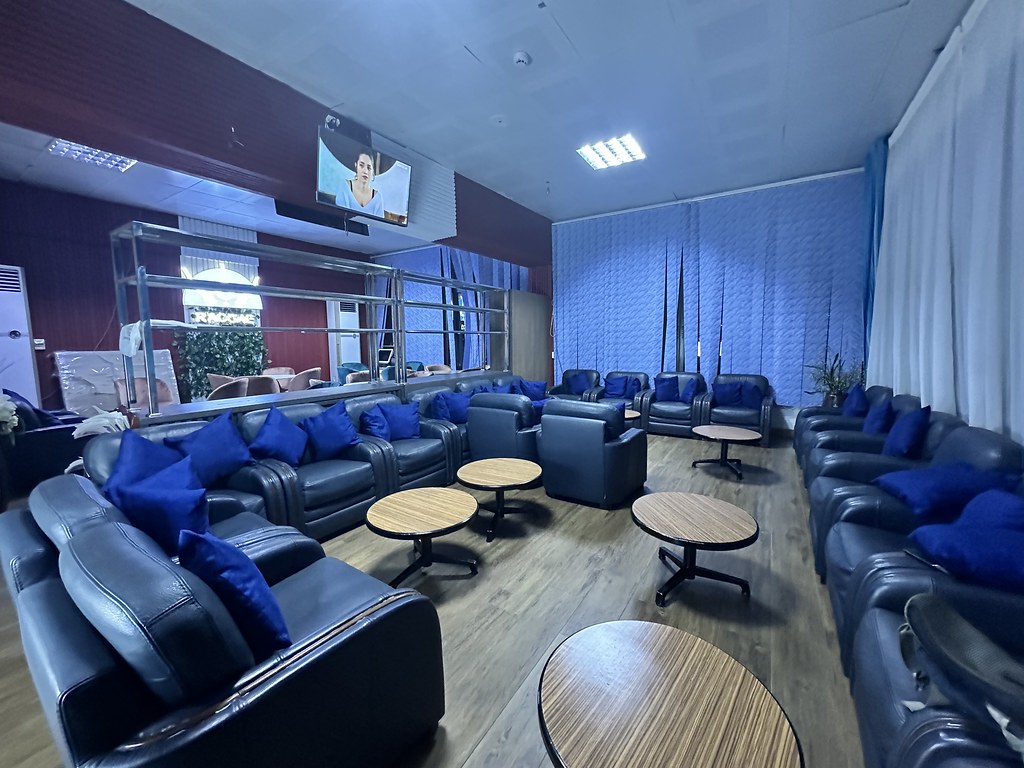
Today:

Mind you at time of posting right now, it appears much of the airport around us is undergoing major renovations. No all-you-can-eat and getting food on your own at this lounge by the way; you’ll have to be served.

After 2 and a half hours struggling with the lounge’s marginal WiFi (it worked on my laptop but not my phone), I changed into pajamas and brushed my teeth before boarding at 9:35pm.
As expected from my previous experience here, even after formal security screening, they inspected luggage one final time before boarding. Since Niamey’s airport had already confiscated my “dangerous” plastic mirror, disposable razor, and 7-year-old nail clipper, things moved “way more quickly.”
At this airport, staff were curious about my vacuum-sealed clothing bag lighting up their metal detector wand, but once I showed them the belt inside, they let me proceed.

We boarded on time at 10pm.

Although I’d planned to skip the meal service for immediate sleep, the charming flight attendants convinced me to eat, so I chose their cod.

After dinner, I slept 4 solid hours until we landed at 5:30am in Brussels. With my extended Brussels layover, I had time to sort out printing my final boarding pass, a task that would have been stressful in Zurich’s 40-minute connection but would be more manageable here.
I first went to the Brussels Airlines service desk. They said that since I’d redeemed miles through United, I had to call United directly. When I called United, they said I needed Brussels Airlines to “tag” my OUA-BRU ticket as used and uncheck me out before they could issue alternative flights.
On my second visit to Brussels Airlines’ service desk, the representative unchecked me and confirmed my OUA-BRU ticket was tagged as used. But when I called United to confirm, they still showed me as checked in. On my third trip to the Brussels Airlines service desk, I put United on speaker. While Brussels Airlines showed me on their screen that I was unchecked, United’s system still showed me checked in. Eventually, both recommended I try the United service desk, while warning it likely wouldn’t work either. They were wrong. The United representative at the airport service desk made several calls and finally found someone who could uncheck me in their system.
However, they could only rebook me using the same ticket code (I), and no alternative flights were available under that code. They recommended I call United’s hotline again.
I called United a third time and finally got answers. The in-person United desk had unchecked me, but since Ethiopian Airlines operated the first leg, they’d initiated the ticket. They could only change flights for free if there was a valid reason, like a delay or missed connection. When I explained I still hadn’t received my ZRH-EWR boarding pass and only had 40 minutes to get it during my Zurich layover, the representative said that seemed like a valid reason. She put me on hold to check with her supervisor.
After 15 minutes on hold she returned and said according to her and her supervisor, this 40 minute layover without an onward ticket yet was indeed a risky layover and shouldn’t have been allowed to be booked in the first place, and offered to change my flight for free. But, then after looking at alternative options, the only option for her was a flight already departing within the hour. Not wanting to rush through security and boarding on this new offer within 40 minutes at the time of the call — the whole point of this process was avoiding the stress of a sub-hour layover — I passed on trading one risk for another. I asked for the next day’s direct flight instead, and they said I should call back once this flight departed.
At 11:30am, I called again. After the new representative initially said it wasn’t possible, I asked her to check with her support team; I still had nothing to lose and plenty of time since I could always fall back on the riskier Brussels-Zurich-Newark routing. After 20-25 minutes on hold, she came back with success: they’d rebooked me on the direct Brussels to Newark flight the next morning!

With no plans for the next two days, I was ecstatic: it was boasted no extra cost, far more convenience, less connection risk, and I was still on business class. I thanked her profusely. Full circle: I’d end where I started, right here in Brussels.
- At time of posting in Niamey, it was 35 °C - Humidity: 31% | Wind Speed: 8km/hr | Cloud Cover: ah, so this is where summer went

