
Let’s just say being here to take this photo at sunset today was worth the wait:

The Visa Maze: When Standard Procedures Is Anything But Standard
Before you get in, you’ll need an entry visa. As an American citizen in 2025, you’d expect the Yemen visa to be a bureaucratic gauntlet; the U.S. State Department maintains a Level 4 “Do Not Travel” advisory for Yemen since the U.S. Embassy in Sana’a had suspended operations years ago, with services allegedly handled remotely through embassies in Riyadh, Djibouti, and Cairo. Commercial visa services list Yemen with “The Embassy of Yemen is not issuing visas at this time” in bold red letters.
BUT don’t lose hope: Americans, Canadians, and British citizens can still secure visas through approved tour operators who obtain special permits from Yemeni authorities. Just like getting a visa to North Korea back in 2011, all we did was send an email to a tour operator saying we were interested. Within 3 weeks, without submitting a physical passport by mail or visiting any embassy, our visas were ready.
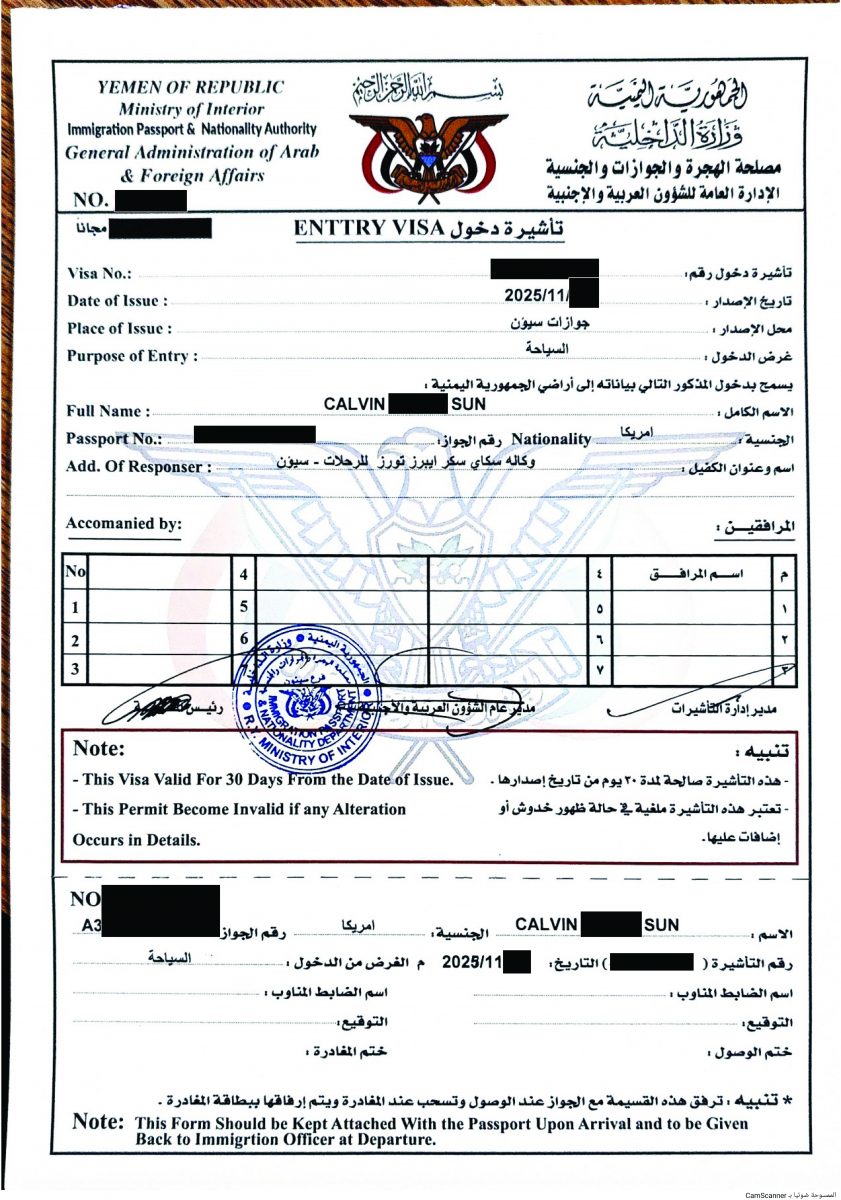
The $3000-$4000 package cost for a week covers the visa process:
- Step 1: Contact an approved tour operator specializing in southern Yemen (Hadramawt region). I worked with Skyscraper Tours via CultureRoad.
- Step 2: I submitted a digital copy of my passport bio page via What’sApp, after which the tour operator submitted on my behalf its detailed itinerary, travel dates, and a letter explaining purpose of visit.
- Step 3: My tour operator then submitted my application to Yemen’s Ministry of Interior and Immigration Department.
- Step 4: We then waited for an approval letter from Yemeni authorities
- Step 5: With approval letter in hand after a few weeks, the tour operator arranges for visa to be issued either at a Yemen diplomatic mission or upon arrival in Yemen.
- Step 6: I was ready to submit proof of round-trip airfare and two passport photos, but that ended up not being necessary as my tour operator booked the roundtrip airfare on my behalf from Cairo.
Like Iran and North Korea, Yemen mandates organized tours with local guides throughout your stay. Solo travel isn’t permitted for Americans in current conditions.
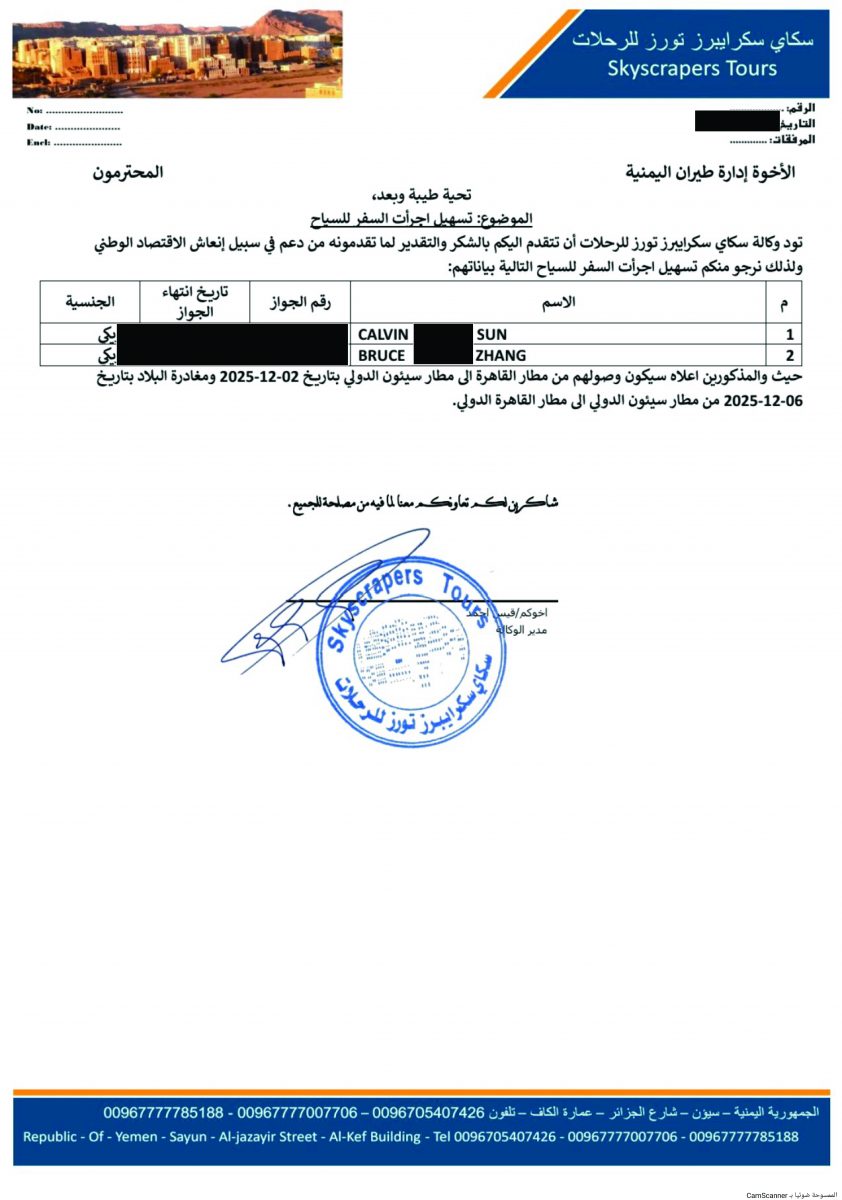
Then you need flights, which your tour company arranges as part of the package. The Cairo-Seiyun route operates seasonally, running 3 times a week from October through March on Yemen Airways (aka Yemenia):
Tuesdays
CAI to GXF, 9:30 am – 2:00 pm
GXF to CAI, 3:30 pm – 6:15 pm
Thursdays
CAI to GXF, 11:30 am – 4:00 pm
GXF to CAI, 05:30 pm – 8:15 pm
Saturdays
CAI to GXF, 10:45 am – 3:00 pm
GXF to CAI, 07:00 am – 9:45 am
Cairo to Seiyun: The Only Way In
With visa approval secured and just two countries remaining on my UN list (Sudan and Niger outside its international airport, plus this Yemen visit since I never explored the mainland outside Seiyun’s airport back in 2019 (….I did spend a week in Yemen’s Socotra, but that’s like saying you visited all of Denmark by visiting Greenland), I began my journey.
Started at JFK, where I finally visited Capital One’s new lounge in Terminal 4.

Without a doubt the best lounge in Terminal 4 (haven’t yet visited Virgin’s Clubhouse or Delta One, but this has the advantage of being newest). The amenities set it apart: a “Cheesemonger” station with wine and cheese tastings led by a dedicated cheese chef (reservations only but this swell guy behind the counter still gave me a generous assortment sampling):

…and a coffee station featuring Ess-a-Bagel’s bagels (not as great as getting them from the original shop in the city).

The other two flagship lounges, Chase Sapphire and Amex Centurion, are worth checking out if you have time and don’t like bagels.

Chase Sapphire had the longest lines. I had to join a waitlist that took 15 minutes. Nice and clean, but crowded compared to Capital One with fewer unique food options.

Amex Centurion next door got rid of their Equinox partnership and replaced that former space with their own café featuring Blue Roast coffee.

They still maintain their partnership with Overstory in the speakeasy bar downstairs called 1850:

After itchy feet got me all around Terminal 4, Capital One’s new lounge was the clear winner.

Once again I used a 60k mileage redemption to fly free on Singapore Airlines Business Class to Frankfurt on the same flight I’d enjoyed 4 months prior. Literal déjà vu.

This time I napped first before the meal, which they agreed to accommodate!

After a 3 hour slumber, I woke up and requested meal service. Unlike before, the “Book the Cook” feature worked on check-in this time, so I got Hainanese Chicken Rice for dinner.

Breakfast followed soon after: egg and pork belly.

After landing in Frankfurt for a few hours and continuing on Brussels Airlines to Brussels, I spent the day recovering from jet lag using points at the centrally located Cardo Brussels:


Last night I finally arrived at Cairo International Airport via EgyptAir from Brussels, also on business class redeemed with miles. Out of convenience for our 9:30am Yemenia Airways flight IY607 the next morning, Bruce (a 3 time monsooner, and my former scribe turned medical student at my alma mater and future orthopedic surgeon beginning in 7 months!) and I booked a night at the Le Meridien Airport Hotel attached to Cairo’s Terminal 3.
Yemen Airways, or Yemenia, is the national carrier and virtually the only way to reach southern Yemen commercially. The airline operates an aging (12-14 years old) but serviceable fleet of Airbus aircraft…erm… did they update their software in time?
From Le Meridien, Bruce and I woke around 7am and got actual coffee (like, not Nescafé) in the hotel lobby. After checkout, we took their on-demand shuttle on the 10 minute drive to Cairo Airport Terminal 1.
Ah, Cairo Terminal 1. Probably another circle of hell. Last time I posted about it, I was writing at 3am while waiting to board my flight to Seiyun too throttled by shock and awe over what I’d just been through. This time, well-rested at a reasonable hour, I can describe the ordeal properly: Unlike other terminals of Cairo’s airport complex, you have to go through 2 back to back “lines” (or clusters of people trying to skip each other in something resembling linear movement) for separate security checks just to get your boarding passes.
The first security check is right at the entrance to the primary hall which takes 5-10 minutes. Not so bad. Then, if you’re flying domestic within Egypt, you can probably proceed directly to check-in without another security check. But for international flights, there’s another security screening literally immediately after the first one … like within meters of each other. Literally waiting in line to get onto another, longer line for the exact same thing. I’m not sure if there’s even enough space between them for any variables to change between security screenings.
The wait time can be up to 20 minutes for the second line as many people at this point would have gotten lost wandering before realizing they have to go through another security line, so they’ll try to cut in at the front out of frustration.

Once through the second screening, we were relieved to see no lines at the Yemenia Airways check-in desk; I guess Yemen isn’t the hottest destination right now. This part was straightforward: we presented passports and printed visa documentation, and within minutes got our boarding passes.

These tickets are still so old, I got seated in the smoking section.

From there, headed to passport control for exit stamps, which was another line that looked like 20 minutes long. However, you can pay $15 USD by credit card for the “Fast Lane” on the right to skip this line and face a dedicated officer locked into his phone at his lonely desk to stamp you through. Make sure they stamp both your passport and boarding pass, or you’ll get sent back.
Once through passports, we headed upstairs to the Priority Pass lounge, which got a glow-up since last time.

6 years ago before the glow-up:

After a quick 15 minute breakfast (I recommend the Egyptian dates and hummus), we headed back downstairs to Gate 4, which required another 20 minute wait for security screening. Female passengers go first, as they all need pat-downs by a female officer.

Once all women are through, the female officer switches places with the male officer who’d been screening luggage on the x-ray conveyor belt. The male officer then pats down all male passengers.
Even less than before, there’s literally zero semblance of lines for gate-specific security screening. Feel free to muscle forward if that’s your dream. He might not like it though:

So many x-ray screenings, my luggage now has cancer. But I’m thankful given the circumstances.

The flight was about 40-50% full: mostly Yemeni nationals returning home and a handful of adventure travelers like myself. I noticed 3 Chinese tourists and 1 western-looking female tourist with us.
After 15 minutes in the departures lounge, we boarded our bus. Only one bus needed for everyone on the flight.

Confirming this plane is an Airbus… hope they updated their software just in time.

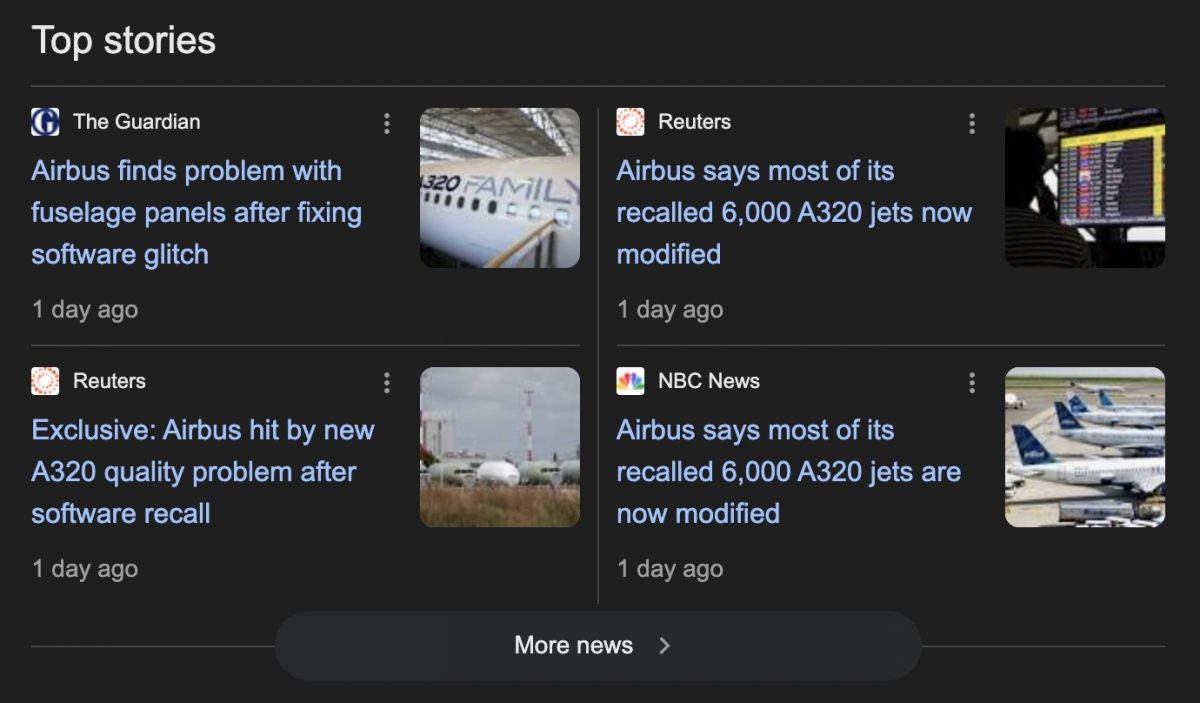
Notice these news articles are just 1 day old!!!
Once on the bus and driving to our plane, we waited another 10 minutes before they opened a single door to let us off one by one. Then once we seated on our flight, we waited another half hour to watch seat negotiations happen around us (though assigned, it’s still a first-come-first-I-get-to-negotiate culture) and wheelchair passengers to board.
Eventually took off nearly an hour late at 10:27am.

Flight details:
- Airline: Yemen Airways (Yemenia)
- Flight: IY605
- Route: Cairo (CAI) → Seiyun (GXF)
- Scheduled: 9:30am – 2:00pm (3h 30m); actual departure 10:27am
- Aircraft: Airbus A320 (pre or post software update? We flew fine, so I guess they updated!)
- Distance: 1,480 miles
Yemenia Airways, where they won’t check if your seat belts are buckled before takeoff, where staff fidget with broken clasps throughout the flight…

…and where a little Arabic gets you great chai, Yemeni coffee (the OG kind) and complimentary medjool dates. The food wasn’t bad either.

Our flight path took us southeast over the Red Sea, across the narrow strait between Africa and the Arabian Peninsula, then deep into the Arabian Desert.

As we descended for my second landing at Seiyun, I returned to Yemen’s largest governorate, the Hadramawt Valley.
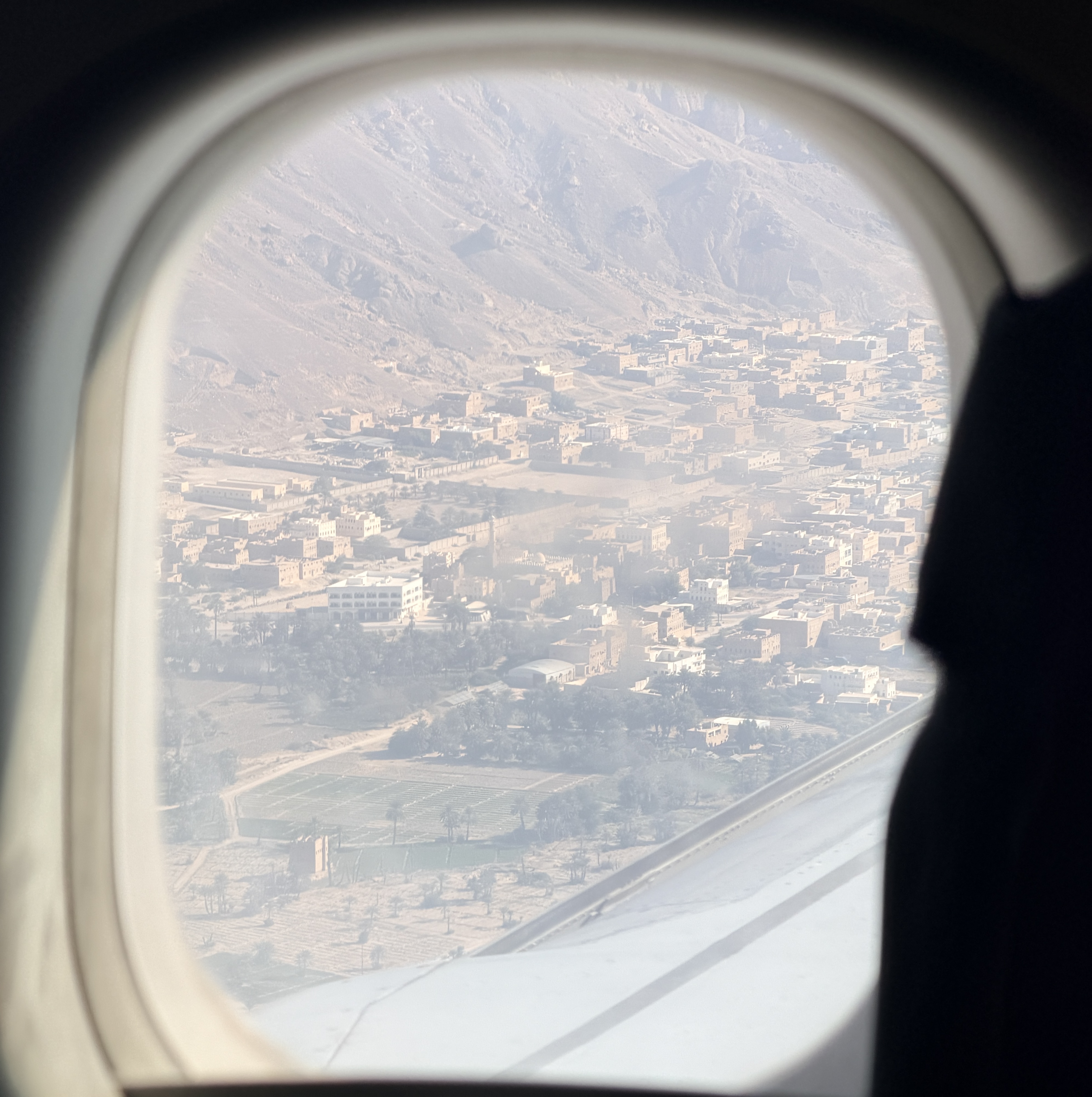
Touchdown in Seiyun: Southern Yemen
When I landed here in 2019, even a glimpse of Seiyun’s airport felt like a locked door to a forbidden world, paradise lost:

Landing at Seiyun Airport again today and seeing new signage constructed on top of the arrivals gate, actually leaving the airport felt surreal.


This small international airport serves as the gateway to the Hadhramaut region, the largest and historically most significant area of southern Yemen.

The terminal is compact but beautiful, and refreshingly uncomplicated compared to Cairo’s Terminal 1.

Immigration moved quickly: Officers at a first desk examined our visa documents and led us to another desk farther down for photos and fingerprints.

We waited 10 minutes and an officer came out asking for “the Americans.” We were led inside an office on the left to take out a page of stickers to put in our passports as visas.

Then with two stamps — one on the visa sticker, another on a slip of paper we were told not to lose until departure (a small entry ticket you receive with your passport when arriving in Yemen, required when exiting) — we cleared immigration within 20 minutes.


Once in the arrivals area, our armed escorts Mohammed and Hossain, with guide Abdul Kareem, walked up to greet us (not many other tourists to mix us up with). Armed escorts are mandatory for tourists in Hadhramaut.


After a series of welcomes and sighs of relief, we drove straight from the airport into Seiyun proper to exchange money. $50 USD gets you 80,000 rials at time of posting:


Within minutes we walked to a local shop to purchase Yemeni outfits in central Seiyun.

The largest city in southern Yemen, Seiyun serves as the administrative capital of the Hadhramaut region and home to approximately 2 million people, 135,000 of whom live in multi-story mud-brick buildings with distinctive white-trimmed windows unique to this region of the Gulf.


We started at the city gate of the old town, predominantly the mud-brick buildings this region is famous for:


Walking through it literally feels like stepping back through centuries:


We made a full loop around the town, keeping our bearings in relation to the centrally dominant Sultan’s Palace, officially known as the Kathiri Palace or Sultan Palace Museum, which appears on the back of every 1000 Yemeni rial bill.

This moonrise’s good timing gives this palace its due:

The Al-Handal Souk provided our first real immersion into daily Yemeni life at the obligatory city market. Unlike tourist-oriented bazaars in other Middle Eastern cities, this market serves only locals. We wandered past stalls selling textiles, fruit, and honey. The atmosphere was calm and friendly, with vendors greeting us with frequent hellos and welcomes without asking us to buy anything. That said, I did buy some keffiyehs as mementos to start my trip.


Hawta: Our Base
During sunset, Mohammed and Abdul Kareem drove us to a viewpoint as kids played soccer in the desert. The sun descends quickly in the desert. As golden hour transitioned to dusk, the valley’s character transformed. Lights flickered on, the call to prayer echoed across the valley, and the temperature dropped from comfortable to cool in minutes.

We then drove approximately 20 minutes into Hawta, a smaller, quieter town that would serve as our base for most of our nights this week. The accommodation was gorgeous. Couldn’t ask for anything more.


..and we started off with some shisha from the rooftops.

For dinner: curry chicken, grilled fish, local hummus, fruit, and in Bruce’s words, “the best lentil soup I ever had.”
Sitting back on the rooftop with the leftovers of our shisha after that first meal, I reflected on the 6 year journey since reaching this point. The first visit before heading to Socotra, reading news of Yemen’s complex developments and setbacks, the visa complications, the limited flight options, the State Department warnings, the logistical complexity…all of it faded into the background against the reality of actually being here (although I think I spoke too soon here considering what we woke up to the next morning…).

Welcome to southern Yemen: a place where civilization has thrived for millennia despite (or because of) its unique environment. A region that produced frankincense for ancient trade routes, architectural innovations that predate skyscrapers by centuries, and Islamic scholarship that has influenced the entire Muslim world.
It’s great to be back.
- At time of posting in Seiyun, it was 28 °C - Humidity: 29% | Wind Speed: 8km/hr | Cloud Cover: this is perfect weather. seriously.

