
Identical twins. This was a birth by a thousand cuts. A story as old as time, for two lives as new as right now, where spontaneity gets sandwiched between a relentless tango with death.
They were born after one of the hardest chapters of our lives: a rare condition called TAPS, sFGR, severe preeclampsia, a 54-day hospital stay for mom, abnormal end diastolic flow, and a hemorrhage 4 hours after delivery that required a massive transfusion protocol, JADA, and nearly took her life. For now, everyone is safe.
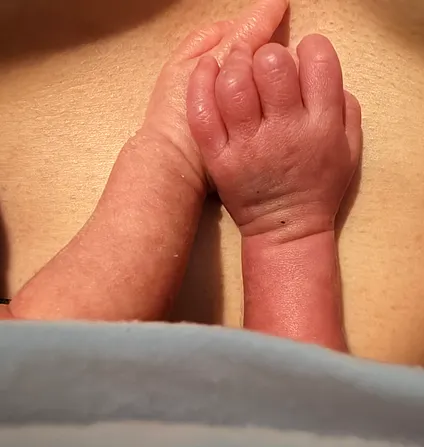
Here’s the whole story so far, because we’re still trying to process what just happened:
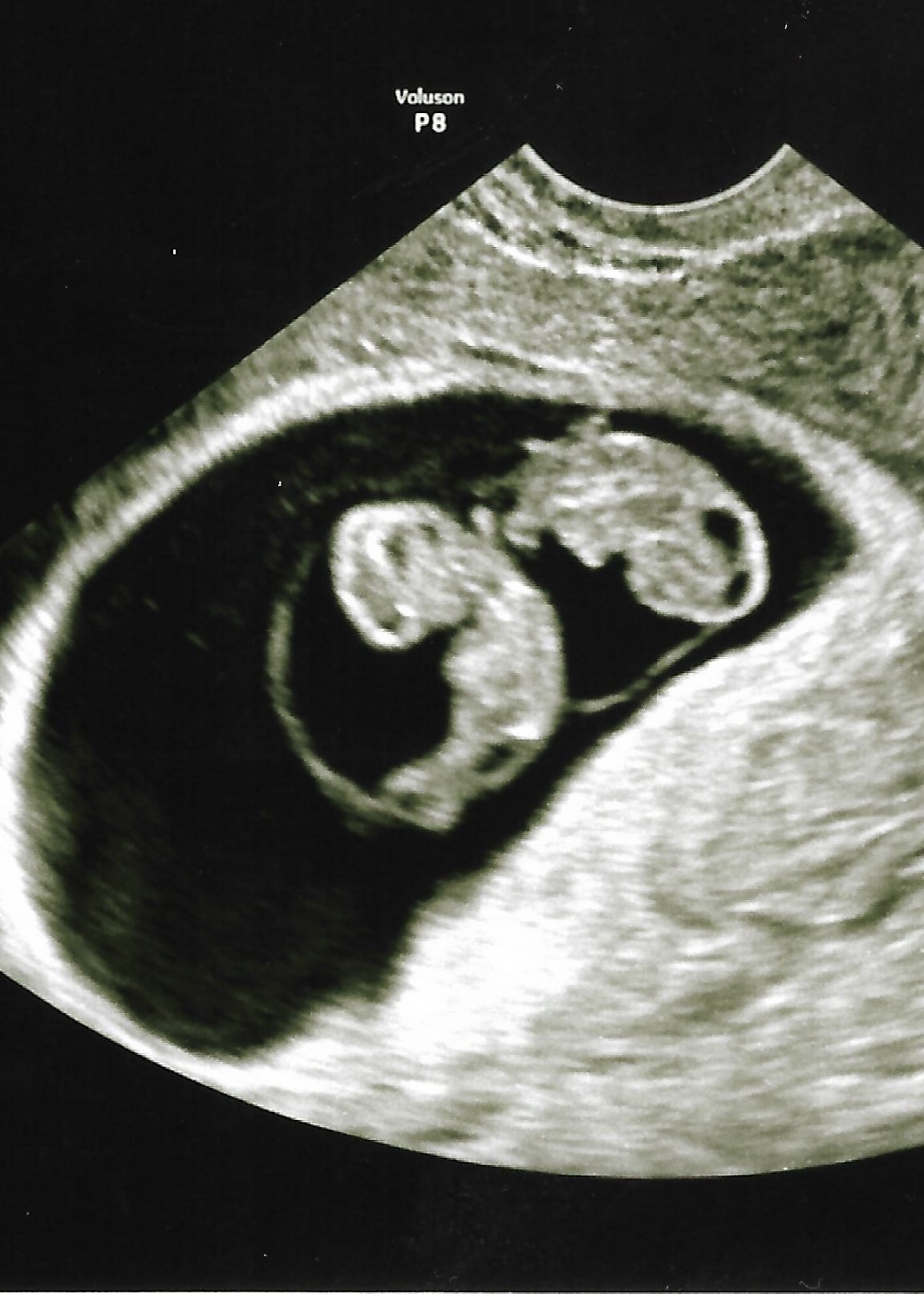
Their story began this past May at Week 22 of the pregnancy, where we found abnormal blood-flow speeds in both twins’ brains (their Middle Cerebral Artery, or MCA, values), a sign of a rare condition called Twin Anemia Polycythemia Sequence, or TAPS — identified in only 3% of spontaneous identical twin births and only ~249 cases since 2007 according to the largest cohort study (Tollenaar 2021) — where one twin slowly sacrifices her own blood for the other (also known as “the donor twin”)
On top of that, that donor twin began falling dangerously behind in growth (a condition called selective Fetal Growth Restriction, or sFGR).
We were therefore asked to return the next day for another screening to confirm the diagnoses, kicking off a marathon of 3-4 ultrasounds every week to monitor for worsening of this rare condition.
On Week 24 on May 18, due to worsening MCA values on another repeat ultrasound, a senior physician and department chair advised terminating them early and “starting all over.” This obliterated us. We walked out shattered, with no idea who to talk to, where to go, or what to do.
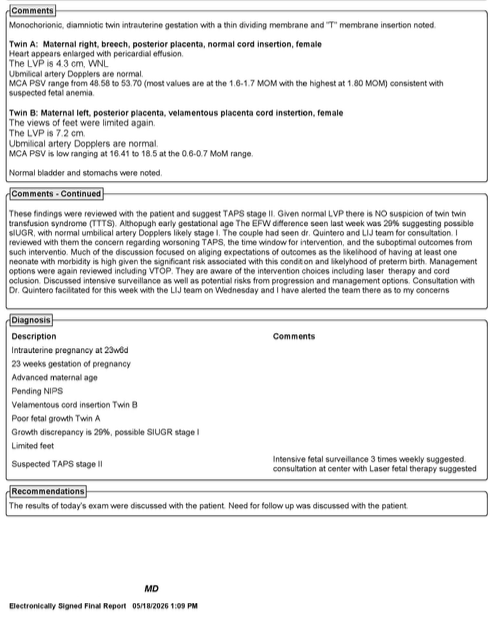
VTOP: Voluntary Termination of Pregnancy
Then, a few hours later, we got a phone call from the world-renowned Fetal Center at Children’s Hospital of Philadelphia (CHOP).
Within half an hour we were on the Amtrak to Philadelphia. And within 24 hours after that first call, the Johns Hopkins Children’s Center-trained multi-disciplinary team at CHOP (“we got a lotta eyeballs on you and these twins right now,” our ultrasound tech said at 7am) offered a temporizing treatment, not a cure: at least 5-6 weekly blood transfusions into the donor twin while still in the womb (intrauterine transfusions, or IUT) and partial exchange transfusions (or PET) for the recipient twin. IUT/PET’s risks of fetal demise compound to around 5-17% over the full course. We said “perhaps, yes,” and they set us up for pre-op that same day, but we asked for one more day before actually going through with it.
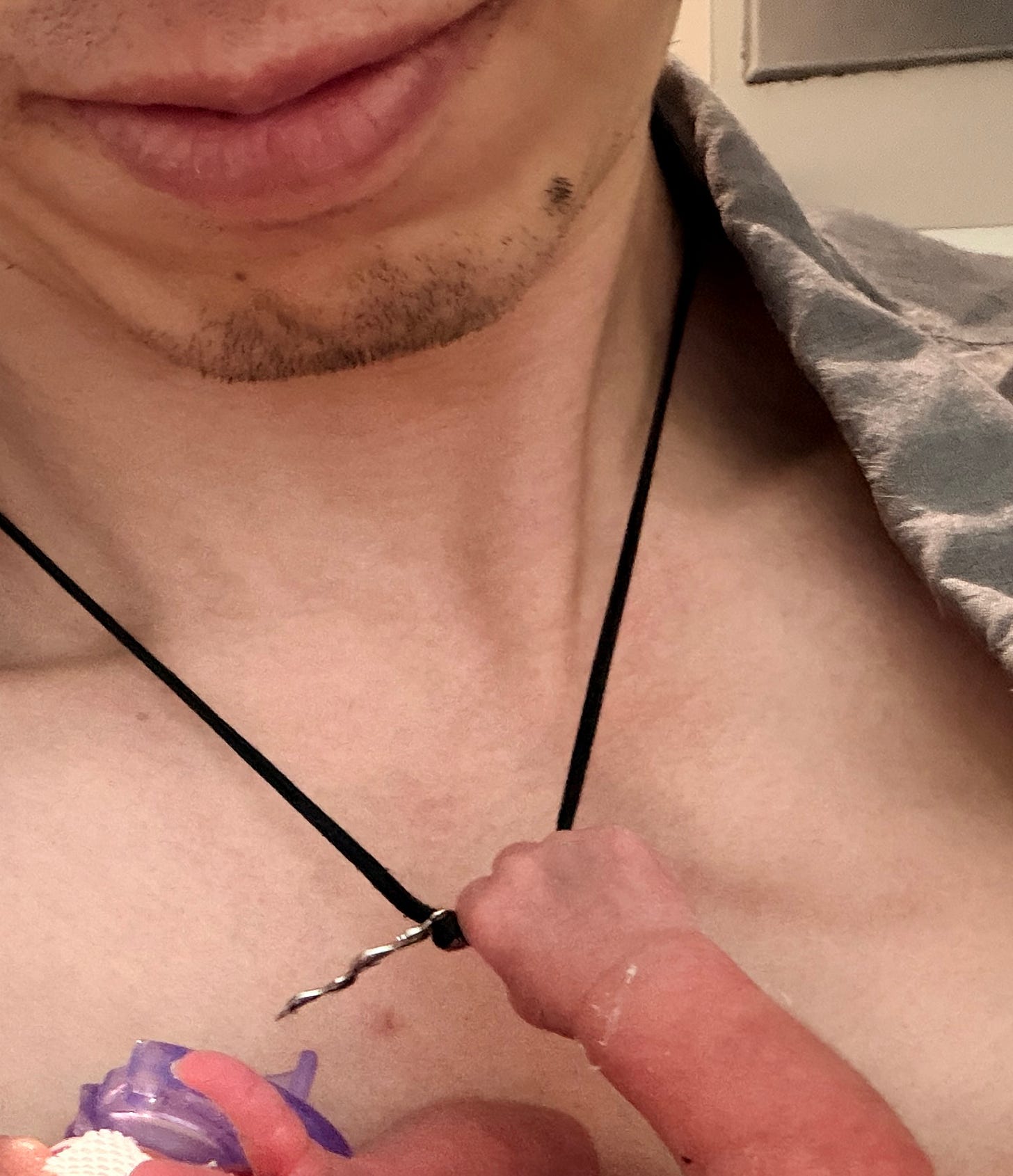
Then 24 hours later, we were back in NYC at Northwell Health LIJ’s high risk pregnancy campus with one of the world’s foremost fetal surgeons on FaceTime from Miami: Dr. Ruben Quintero of The Fetal Institute, who pioneered the laser surgery for twin complications (the staging system for the better-known Twin-to-Twin Transfusion Syndrome bears his name). His intrauterine laser surgery was another offer entirely: a definitive cure, not just a treatment, but one carrying a 10-16% risk of fetal demise.
Except, as he guided our sonographer and fellow live over FaceTime, he found something that changed the plan: a rare, large connecting vessel between the twins (a bidirectional artery-artery, or AA, anastomosis) that most TAPS placentas don’t have. In his determination, this vessel was secretly acting as a natural pressure-release valve between our twins.
So the man who invented the cure then advised us against his own cure. His rationale: if we truly had this vessel, any surgery with him or treatment at CHOP now carried more risk than benefit, so he proposed expectant management (“watch and wait”) and suggested we *not* return to CHOP for the transfusions either, as the vessel could theoretically even stabilize the TAPS on its own.
And above all, he believed there was still a sizable chance we could still come out of this with 2 healthy babies
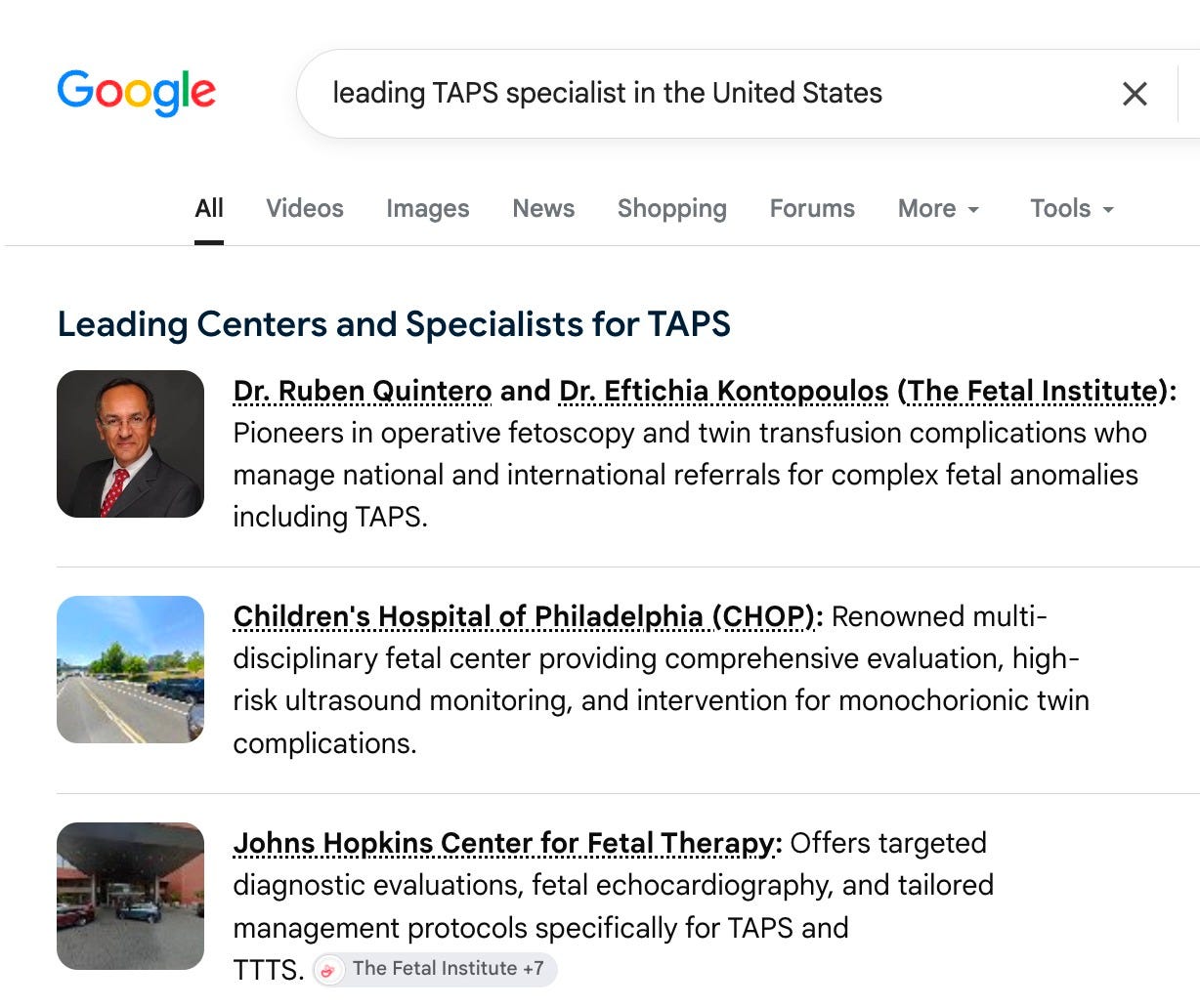
In case it’s not obvious how much we were trusting a total stranger on a FaceTime call from Miami that conflicted with the advice we received 24 hours earlier from CHOP: This is what came up when I searched for who treats TAPS in this country a few hours after his call, because even a physician like myself wants a second (or third) opinion on whether to trust a stranger’s life-altering advice. . . . And don’t think for a second we knew how to look for them; we had no clue where to start or what to do when we were told that terminating and “starting all over” was the recommendation. We truly felt like something was looking out for us when CHOP called us a few hours later to schedule a 7am appointment the next day. And then again when we’d find out that Dr. Quintero got looped in through our own team via a recent relationship established by Northwell Health. We can’t thank these two enough how they unpredictably reached out to us (or TAPS is just that rare) and how the third on this list had trained the CHOP team. But in another sense, both giving us opposite advice within 48 hours manifested another layer of angst and turmoil…)
In other words, all our experts already knew one twin was sacrificing blood for the other. Only Dr. Quintero found the vessel suggesting that the recipient twin was secretly giving enough of it back.
And that’s what made this so agonizing: CHOP’s scans the day before hadn’t found such a vessel. So from where CHOP stood, the transfusions’ benefits clearly outweighed their risks; it was the responsible move for the twins they saw.
But from where Dr. Quintero stood, with the rare vessel now on his radar, he theorized any intervention carried more risk than benefit; it was the responsible move for the twins he saw.
Two world-class entities, both acting rationally, looking at two different pictures of the same womb.
So there we were: our twins had developed a rare and dangerous placental physiology that, theoretically and surprisingly, was compensating for itself. This left us in a management gray zone with no clear winner: a cumulative risk of 5-17% for the weekly transfusions, 10-16% for laser surgery, a 16% chance TAPS could resolve on its own, and up to 22% of donor twins who don’t survive without any intervention at all. Every option carried real odds of loss, and none of them stood out as obviously safer than the rest. So little is known about TAPS that there was no confident answer either way.
We were thrown beyond the deep end – an abyss – involving a decision-making few have experienced so early and untested in parenthood. To reiterate: 4 excruciating and uncertain options, all weighted roughly equally by different experts:
1. Terminate, and “you remove all the variables.”
2. Temporizing treatments at CHOP: 5-17% risk.
3. Curative laser surgery by Dr. Quintero: 10-16% risk.
4. Expectant management, “watch and wait,” which carried its own two excruciatingly uncertain outcomes: a) Up to 22% of donor twins don’t survive without intervention. b) No more than 16% of TAPS cases have been observed to resolve on their own.
A 5-chamber Russian roulette with no obvious answer. How would you have chosen, for a condition barely any literature exists for?
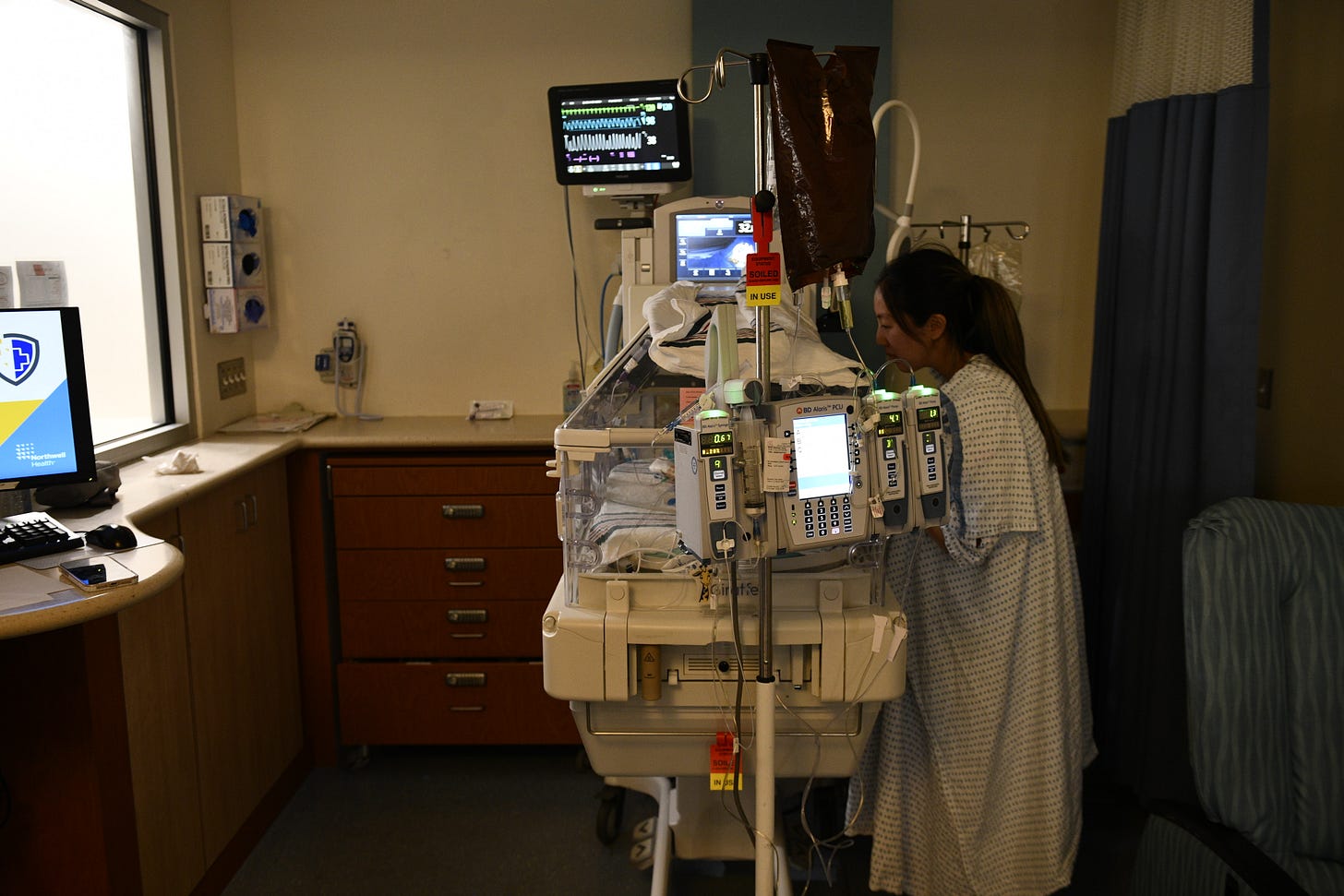
…We chose trusting the process on our poorly designed roller coaster, knowing to never make decisions rooted from fear. We therefore relied on a rare, large bidirectional AA anastomosis that chose for us. A vessel so rare only one doctor knew to look for it in these edge cases, because it’s nearly impossible to diagnose something for which no established literature yet exists.
Dr. Quintero’s recommendation of expectant management reminded me that in medicine, “watch and wait” isn’t “freezing” or inaction, even though inaction is exactly what it felt like to us (and what would have carried the guilt if we’d been wrong). Pausing, only after gathering all the information we could, became the real decision; a conscious choice to trust and live a process we couldn’t predict.
We therefore woke up every morning for months to this unspeakable agony of not knowing if we were making the right life-or-death decision, where every day we could still change the plan. But our pausing would guide us to our north star for every other decision we’d make: never make a decision out of fear.
And day by day, scan by scan, TAPS remained stable instead of worsening. And by week 26, on June 8’s follow-up ultrasound, the TAPS was determined to have miraculously and completely self-resolved, with values no longer even meeting the threshold for a TAPS diagnosis just as Dr. Quintero predicted.
But then, amidst all this good news, Melissa D Jeng asked to check a blood pressure before leaving for work.
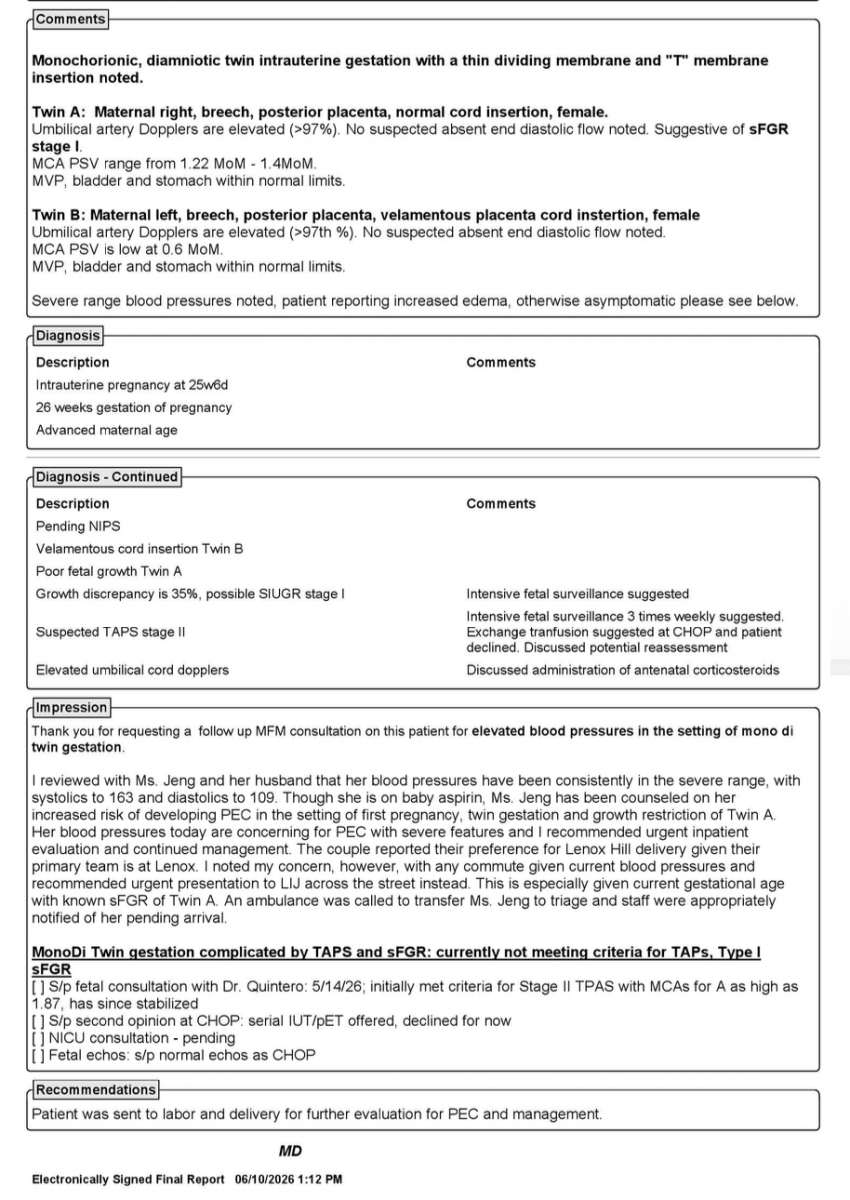
Within minutes she was diagnosed with severe preeclampsia and transferred by ambulance directly from the ultrasound room to labor and delivery for urgent evaluation at Katz Institute for Women’s Health across the street, and 2 hours away from home. So we made it our second home; she would end up staying there as an inpatient for 54 days total, from admission through recovery (thank you to all the friends and family who visited us!)
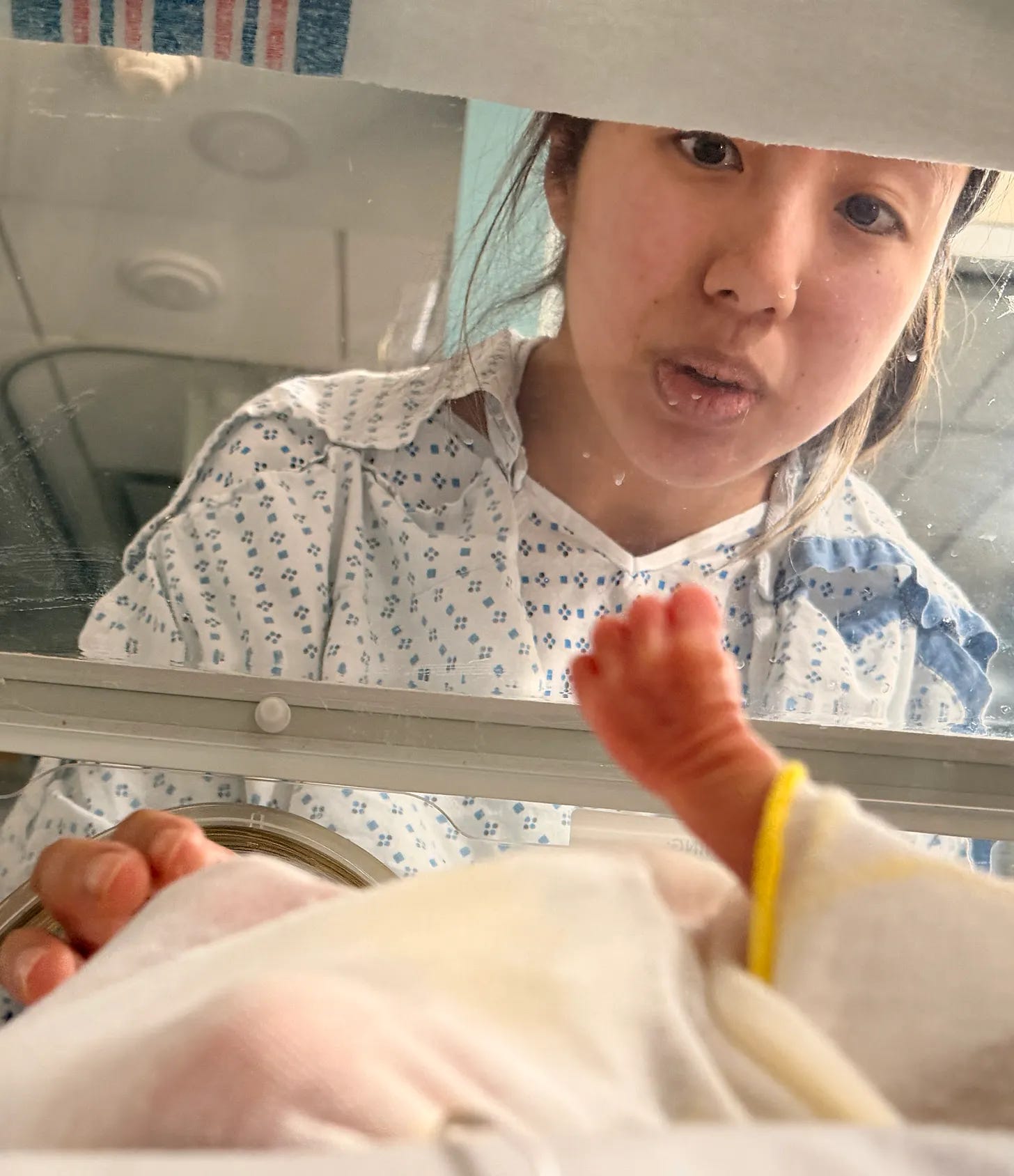
On the day of her admission on June 8, we asked the team at Cohen Childrens Medical Center of NY’s Level IV NICU to be honest when they stopped by; their hope was that her blood pressure would drop back down enough to avoid delivering within the week, and that our twins could ideally stay 36 more days in the womb, to reach 32 weeks.
And no lie after all we’ve been through so far, the thought of holding out for 36 more days at the hospital with severe preeclampsia felt insurmountable.
But we spoke to our kids, and they understood the assignment …but not without first pulling some fast ones on us: after 48 days of relentless false alarms every other day, pressures going up and down and back up, abnormal cord blood flow, low platelets, early contractions, fetal heart rate decelerations, and betamethasone (a steroid that accelerates their lung maturation when delivery looks imminent within 7 days) given twice at week 27 and 31, they held out to not just 32 weeks…
…but at a miracle 33 weeks and 5 days on a Sunday morning at the cusp of sunrise.

And then, 4 hours after delivery, their mom almost died.
I was next to her when I noticed she’d gone pale, then saw the bleeding. I “froze” into work-mode autopilot; sternal rubs to keep her awake, except this patient was my partner. Her blood pressure dropped to 70/50, so her team activated a massive transfusion protocol and surgical rapid response team, and within minutes it felt like half the hospital was in the room. Blood clots from delivery were blocking her uterus from clamping down to stop the bleeding on its own; the team had to remove them by hand (imagine the feeling of going into labor after a c-section) before placing an internal suction device (JADA) to finish the job.
Her hemoglobin crashed 5.9 points, then climbed back after 2 units of blood as the JADA did its work. She’s stable now, and we’ll be staying out here at Ronald McDonald House of Long Island for an additional 1-2 months while the twins are in the NICU.
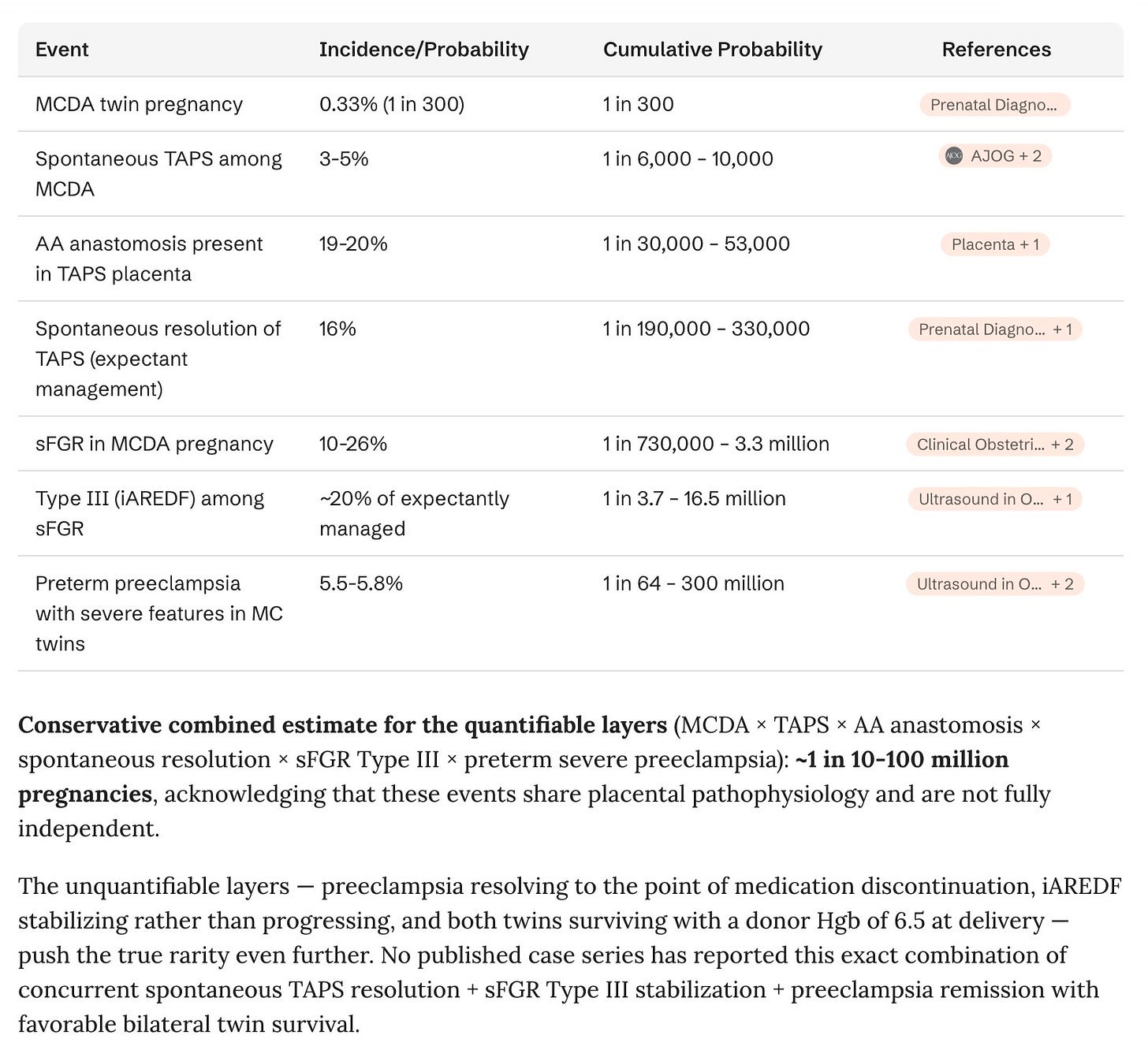
Just to take all this into perspective: spontaneous monochorionic diamniotic (2 sacs sharing 1 placenta) identical twins like ours occur in 0.33% of pregnancies. 3% of those develop TAPS. Only 19% of TAPS placentas even have an AA anastomosis. Only 16% resolve spontaneously like ours. That’s already starting off at least 1 in 365,000, using just those 4 factors alone. Then factor in the sFGR type I and III and the severe preeclampsia she also had, adjusted for the fact that these all share the same placental pathophysiology, and the fuller picture above suggests these twins landed somewhere at 1 out of 10 million pregnancies. That’s the equivalent of getting struck by lightning twice (no pun intended):
Baby A sacrificed for Baby B so she could live. Baby B saved Baby A right back.
This is their story so far.
And I’m still figuring out what it means for mine and ours.
More soon.

- At time of posting in Glen Oaks, Queens, it was 28 °C - Humidity: 44% | Wind Speed: 6km/hr | Cloud Cover: clear and beautiful

