
Months ago I decided to gift myself a week off after Labor Day…simply because I could. After a year as wild as this past one, I craved actual and intentional self-prioritization to restore some balance.
Finding fares under $200, I booked a morning departure: a 1.5-hour United flight (UA 8207) from Newark to Halifax (10:25am to 12:00pm), followed by a quick layover and a raid of the Maple Leaf Lounge’s to-go offerings in Montreal before catching the 2-hour UA 8407 flight from Halifax to St. John’s (1:05–5:09pm).

Within 6 hours door-to-door (or arrivals), we touched down in one of North America’s easternmost cities and Canada’s oldest settlement.


After landing, we rented a car from Avis and drove 20 minutes south to our Airbnb on Water Street, right in the middle of the oldest street in Canada’s first city.

St. John’s felt like a place to slow down and linger. So we did.
Over the next three days, we cobbled together a self-guided exploration, including a day for Mel to catch up on remote work and a spontaneous road trip west with a stop at the curiously named town of Dildo. Together, these experiences became our crash course in Newfoundland history, coastal geography, and fierce local pride…

. . . especially when it came to their beloved Newfoundland dogs and Labrador retrievers.

A Walking Tour Through History
After parking at the Alt Hotel for $15 CAD per night, we crossed the street and discovered our unconventional check-in process: walking through the buzzing restaurant Portage (which became one of our favorites the following evening) and casually taking the elevator in the back of their dining room…no front desk required.
The entire building had once been “The Luxury Suites” hotel, but after business declined, private investors converted it into separate Airbnb units, transforming the downstairs reception into the restaurant. With a laundry machine and kitchenette right outside our room, it became the perfect setup.
We settled in and began our stroll at Terry Fox Mile 0, the small park where a young Canadian fighting cancer dipped his foot into the Atlantic before beginning his 1980 Marathon of Hope.


We continued along the waterfront, passing the World War I memorial honoring St. John’s role in the war effort.


As the sun dipped below the horizon, we watched the rising Blood Moon cast its ethereal glow over the harbor.


Just as the sky deepened into night, we settled into a 90-minute Yin-style restorative yoga session at the nearby Modo Yoga studio.
By 9:30pm, we emerged both energized and at peace, then wandered down George Street to hear live music spilling from every doorway.

At local favorite Christian’s, you can get “screeched in”: a ritual performed on non-Newfoundlanders (known to locals as “come from aways” or “mainlanders”) involving a shot of screech, a short recitation, and kissing a cod. You’ll even receive your own certificate!

Savoring the Slower Pace
The next morning, after a leisurely start, we had breakfast at Bagel Café, which proudly claims to serve the best breakfast in Canada’s oldest town.

We then walked past the Supreme Court, admiring its unique granite-and-sandstone facade facing both Duckworth and Water Streets.

After a detour to Dildo on the second day, we began our third day at Signal Hill: the site where Marconi received the first transatlantic wireless signal in 1901.
Despite signs boasting that the cannon fires every noon and has missed only a handful of days in over a century, it remained silent during our visit. We waited, too!

The climb to the top rewards you with breathtaking panoramic views.


From here, we traced the cliffs to The Battery, a former sleepy fishing village now transformed into a colorful hillside neighborhood that houses a geology museum.

We briefly stopped at the downtown Sheraton, which looked like it contained its own ecosystem.

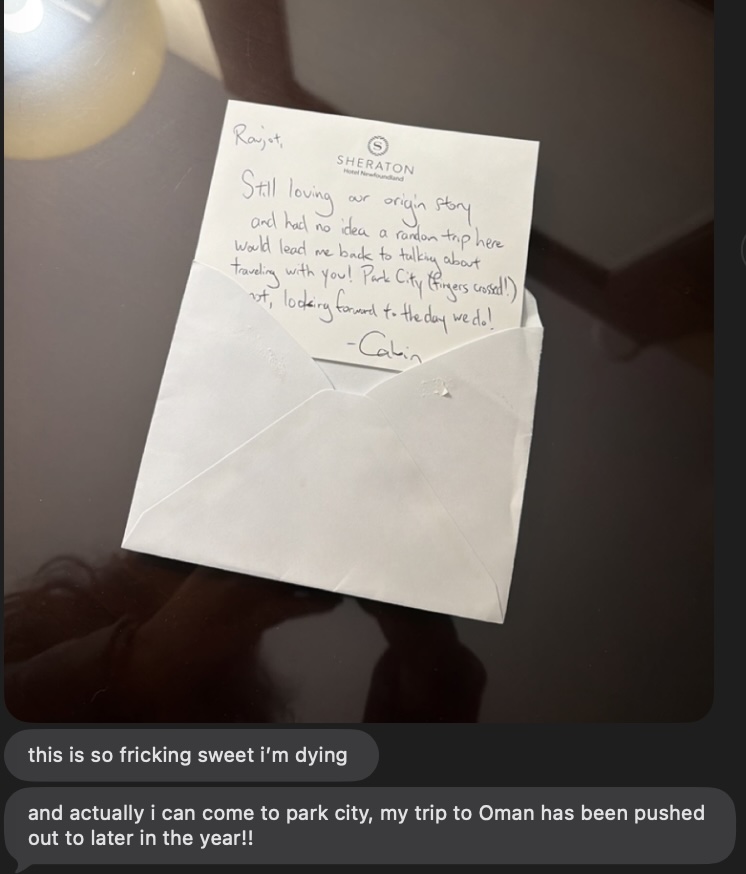
Having just received an Instagram message from a friend I’d made in NYC a few weeks ago — who works as a consultant in St. John’s and regularly stays at this very hotel — I left her a note at the front desk for her next visit.

– Edit on Sunday November 2, 2025 –
7 weeks later, she received it!
Architectural Treasures and Cultural Gems
After parking near Bannerman Park . . .

. . . we sauntered over to The Colonial Building. Constructed from white limestone imported from Cork, Ireland, it served as the seat of government until 1959.

From there, we reached Government House, the official residence of Newfoundland’s Lieutenant Governor.

We admired the manicured flowerbeds, and if you’re lucky you can go inside to sign the guestbook inside and snag free postcards.

Just up the road, the Commissariat House offers a glimpse into 1830s life through well-preserved rooms.

Next, we drove uphill to The Rooms, a striking modern structure housing the Provincial Archives, art galleries, and the Newfoundland Museum.


Built on the site of Fort Townsend, it now serves as the cultural heart of the city, offering panoramic harbor views from its upper floors.


A short drive south brought us to the Railway Coastal Museum, housed in the 1903 Riverhead Railway Station. Through dioramas, locomotives, and vintage carriages, Newfoundland’s rail and shipping heritage came alive.

We continued past the Fort Amherst overlook — directly across the harbor from Signal Hill — and after a 20-minute drive, reached our destination: Cape Spear Lighthouse, home to the easternmost point of Canada’s mainland.

After purchasing tickets, we descended the ramp to the commemorative rock marking Canada’s continental easternmost point.


From there, we explored the remarkably well-preserved World War II bunkers, designed to protect stationed military personnel from bombing runs.


These bunkers also function as tunnels leading up to the two lighthouses crowning the hill.

Climbing the steps from the bunkers, we reached the modern lighthouse, still active but closed to the public.

Just beyond stands the original lighthouse, the site’s oldest structure.

Admission includes entry inside, where you can experience how lighthouse keepers once lived and worked when this beacon first guided ships to safety.

The Churches of St. John’s
- St. Thomas’ Anglican Church: The town’s oldest church, built in 1836 of black timber, modest yet atmospheric.

- Anglican Cathedral of St. John the Baptist: Rebuilt after the Great Fire of 1892, its gothic arches anchor Church Hill with impressive grandeur.

- Basilica Cathedral of St. John the Baptist: This Roman Catholic minor basilica towers above Military Road with twin 43-meter-high spires.

- St. Andrew’s Presbyterian Church: A Gothic Revival beauty with an iconic spire, standing proudly since 1894.

- Gower Street United Church: Completed in 1896 with red brick and a distinctive tower, serving as both landmark and community gathering place.

After three days in St. John’s and our westward road trip adventure that included Dildo, we boarded a direct flight to Saint-Pierre, ready to trade one charmingly quirky world for another.
- At time of posting in St. John's, it was 14 °C - Humidity: 71% | Wind Speed: 11km/hr | Cloud Cover: clear and sunny

